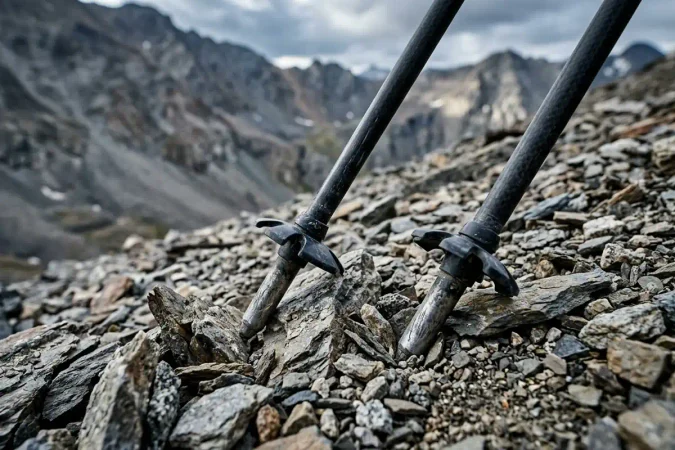
What keeps a hiker upright when the trail turns into a staircase of broken stone? On rock-riddled routes, the best trekking poles for rocky terrain earn their keep in the half-second between a skidding boot and a hard landing — a planted shaft turns a wobble into a stride. Rocky ground asks more of a pole than smooth path ever does: the tip must bite instead of skate, the shaft must take sideways knocks against stone, and the lock must hold when the whole plant loads up with body weight.
Materials decide most of that story. Aluminum shafts forgive the abuse, denting and flexing where harder metals would fail, while carbon trades a little toughness for a light swing and a feel that soaks up trail buzz through the grip. Tip metallurgy matters just as much — a sharp carbide point pierces the seam between rocks and holds where softer metal glances off.
The rest is craft. A locking system that stays put under load, grips shaped for long days of pushing, and straps that carry the hand through descents all separate a confident plant from a nervous one. Poles set to the right length for the grade turn steep ground from a scramble into a rhythm — and that adjustment, more than any other habit, is what rocky-country hikers come to lean on.
Quick Picks
In a hurry? These four jumps take you straight to the full write-up or the listing:
TrailBuddy Trekking Poles — the 7075 aluminum workhorse with the huge following
Cascade Mountain Tech Carbon Poles — the cork-grip dampers for hard descents
Black Diamond Alpine Carbon Cork — the premium anchor for technical stone
Trekology Trek-Z Poles — the folding pair that packs to nothing
Comparison Table
| Product Name | Best For | Price Range | Check Price |
|---|---|---|---|
| TrailBuddy Trekking Poles | All-round rocky-trail reliability | Budget | Check Price |
| Cascade Mountain Tech Carbon Poles | Damped bedrock descents | Mid | Check Price |
| Black Diamond Alpine Carbon Cork | Premium technical terrain | Premium | Check Price |
| Foxelli Trekking Poles | Top-rated everyday pairs | Budget | Check Price |
| Trekology Trek-Z Poles | Packable folding carry | Budget | Check Price |
| Hiker Hunger Carbon Poles | Light carbon with small-brand care | Mid | Check Price |
| LEKI Makalu FX Carbon Poles | European folding carbon | Premium | Check Price |
| Cascade Mountain Tech Aluminum Poles | Value aluminum with grip reach | Budget | Check Price |
Buyer’s Guide
Shopping for the best trekking poles for rocky terrain gets simple once you separate the four decisions that matter from the numbers that only look important on a screen.
Shaft material leads the list. Aluminum bends before it breaks, which makes it the forgiving choice for ground that knocks poles sideways all day; carbon swings lighter and calms the rattle that stone sends through a pole, at the cost of caring how you treat it. Either way, a shaft sized in your hand — not too stubby, not too whippy — plants straighter on uneven ground.
Tip and contact come next. Carbide points stay sharp against abrasive stone and hook into the seams where rock meets rock, and a good basket-and-tip kit lets you match the contact patch to the day. Terrain bites poles, so a build that accepts replacement tips keeps a pair alive for years instead of seasons.
Locks and packing decide daily trust. External lever locks read and re-tighten in seconds with gloves on, twist locks vanish into the shaft but demand a feel for snugness, and folding designs collapse short enough to strap to a pack between scrambles. Whichever system you choose, test it loaded — a lock that slips under body weight is worse than no pole at all.
Finally, weigh the touch points: cork that shapes itself to your palm, foam that warms cold mornings, extended grips for choke-up on steep pitches, and straps that hang the hand without pinching. Contact happens at the grip on every single plant, and that is exactly where long days are won.
One Mistake to Avoid:
The commonest error is running the wrong length for the grade. Hikers lock a pole to flat-ground height and leave it there, so uphill plants reach short and descents dump weight onto palms. Lengthen for the downhill, shorten for the climb, and if your pair adjusts fast, split the two poles a notch apart on rolling rock — the ground stops dictating your posture and your shoulders stop paying for it.
Best Trekking Poles for Rocky Terrain: 8 Stable Picks
Eight pairs earned slots here, each answering stone in its own way. The TrailBuddy set carries the largest following on this page, the Black Diamond anchors the top end, the Trekology folds to pack size, and the two Cascade Mountain Tech builds split the carbon and aluminum lanes — so whichever material camp you pitch your tent in, a steady pair is waiting below the fold.
1. TrailBuddy Trekking Poles
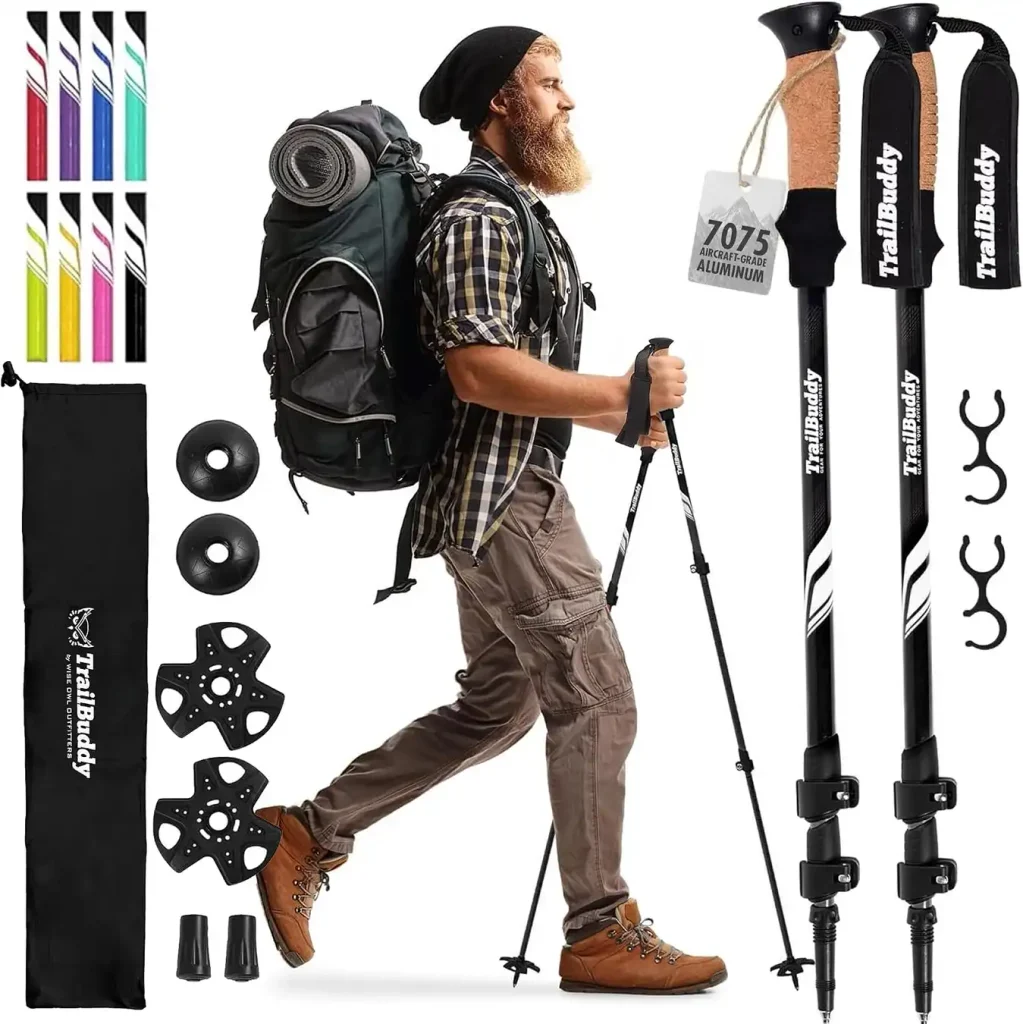
Best for: all-round rocky-trail reliability from a pair the crowd has spoken on.
- 7075 aircraft-grade aluminum: the shaft spec built to flex and survive stone strikes.
- Collapsible two-piece carry: telescopes down to strap onto a pack between pitches.
- Full accessory kit: baskets, tips, and protectors arrive in the box.
- Cork-style grip with foam extension: choke-up control for steep, hand-over-hand ground.
- Colorway shelf: enough finishes that a pair survives being borrowed.
Pros:
- The follower count here dwarfs every other pair on the page.
- Bend-not-break shaft spec suits rockfall-prone routes.
- Kit completeness means nothing else to buy for a first outing.
Cons:
- Offer lane includes third-party sellers, so glance at the buyer box.
- Heavier swing than the carbon builds further down.
- Foam extension collects wear faster than the hard grip.
Plant the TrailBuddy on Amazon
2. Cascade Mountain Tech Carbon Poles
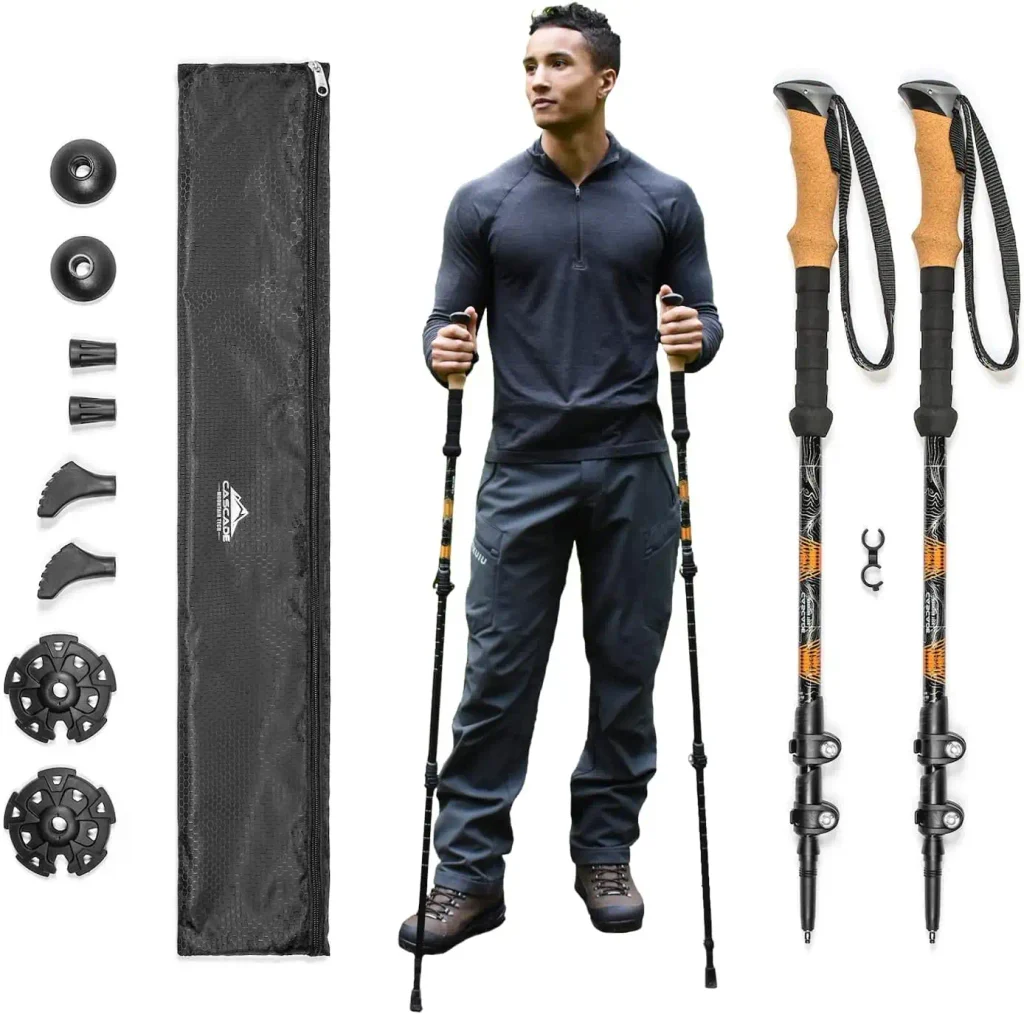
Best for: damped descents off bedrock and hardpack.
- Carbon fiber shafts: cut swing weight and calm the buzz stone sends uphill through the grip.
- Quick adjustable levers: length changes land in seconds with gloves on.
- Natural cork grips: shape to the palm and shrug off sweat on long climbs.
- Tungsten-carbide tips: bite into the seam of the rock instead of skating off it.
- Carry bag included: protection for the shafts when the pack cinches tight.
Pros:
- The comfort pick for knees on long downhill stone staircases.
- Lever locks hold without the fiddle of twist systems.
- A quiet favorite of the rocky-trail crowd on this list.
Cons:
- Carbon demands gentler treatment against sharp edges than aluminum.
- Sole colorway, so scuffs show.
- Extended carry bag runs longer than most pack straps expect.
Roll Carbon with the CMT on Amazon
3. Black Diamond Alpine Carbon Cork
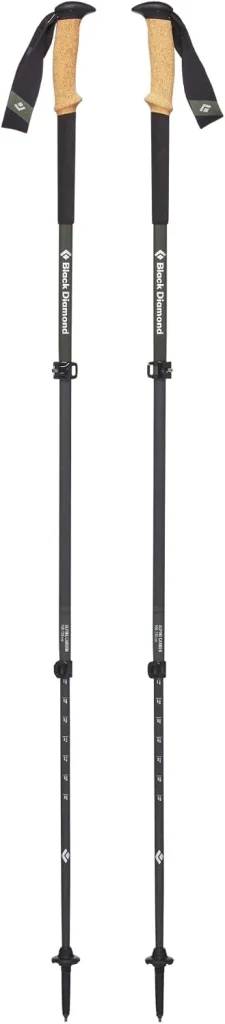
Best for: premium confidence on technical, off-trail stone.
- FlickLock Pro levers: the metal leverage lock tuned for hard loads and cold hands.
- Carbon construction with cork grip: the classic pairing of light swing and shaped comfort.
- Carbide tips standard: the brand’s own spec aimed at dirt, rock, and variable ground.
- Interchangeable baskets: swapped for season and surface without tools.
- Backcountry pedigree: built by a house that names its locks after rock seasons.
Pros:
- The invest-once build for hikers who never leave stone behind.
- Lock authority under load is the benchmark the others chase.
- Direct-from-brand channel with the maker standing behind it.
Cons:
- Top-shelf positioning above every other pair here.
- Minimalist color range at any given time.
- Grip sizing runs specific, so handle before committing if you can.
Summit with the Black Diamond on Amazon
4. Foxelli Trekking Poles
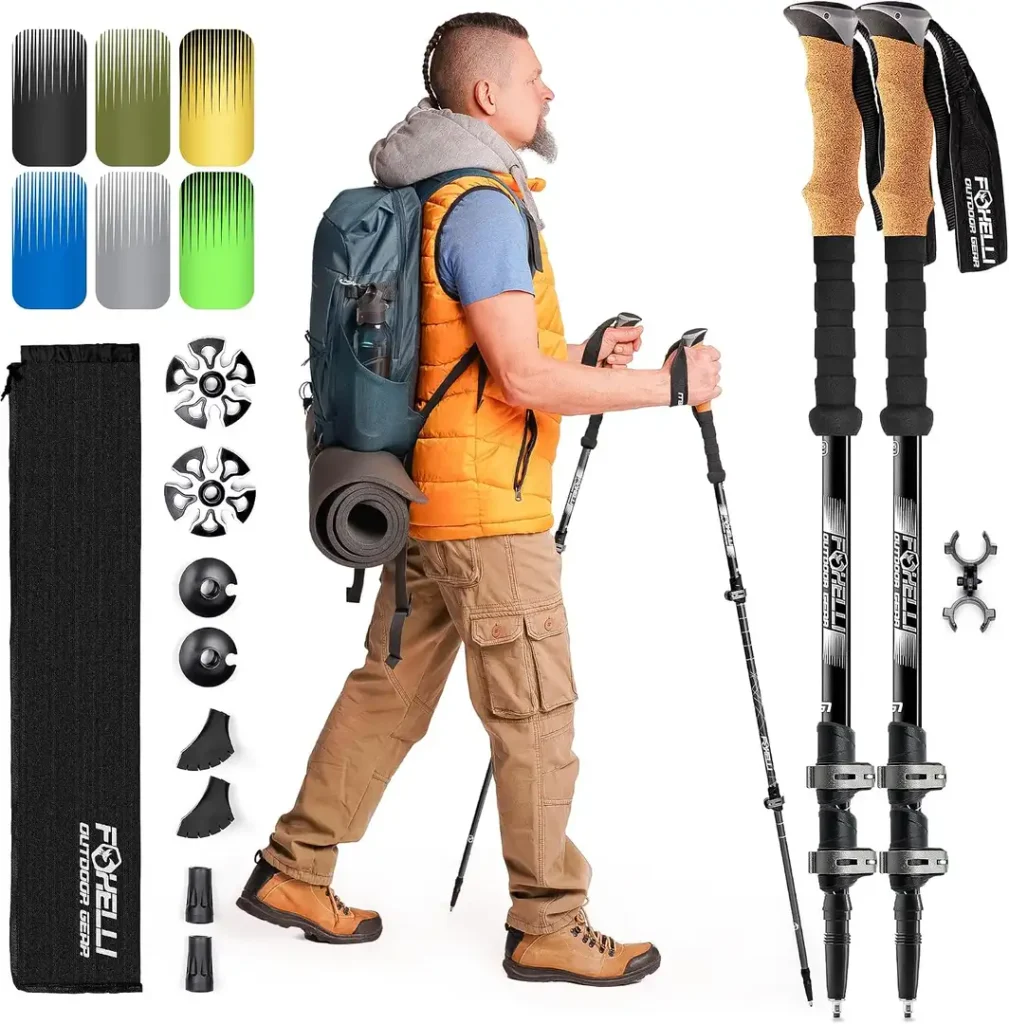
Best for: the top-rated everyday pair for mixed rocky trail.
- Aircraft-grade aluminum shafts: the durable swing for daily contact with stone.
- Natural cork grips: wick sweat and mold to the hand over a season.
- Quick-lock adjustment: external levers sized for glove use on the move.
- Padded, moisture-wicking straps: carry the hand through long descents without chafe.
- Brand-direct channel: sold by the maker’s own house with fulfillment behind it.
Pros:
- Carries the highest reader standing on this page.
- A colorway for every kit, from understated to loud.
- The everyman length range fits most torsos without thought.
Cons:
- The carbon sibling sits out this round, so aluminum is the lane.
- Grip diameter leans average — big hands may want the next size.
- Strap padding takes a season to compress to shape.
5. Trekology Trek-Z Poles
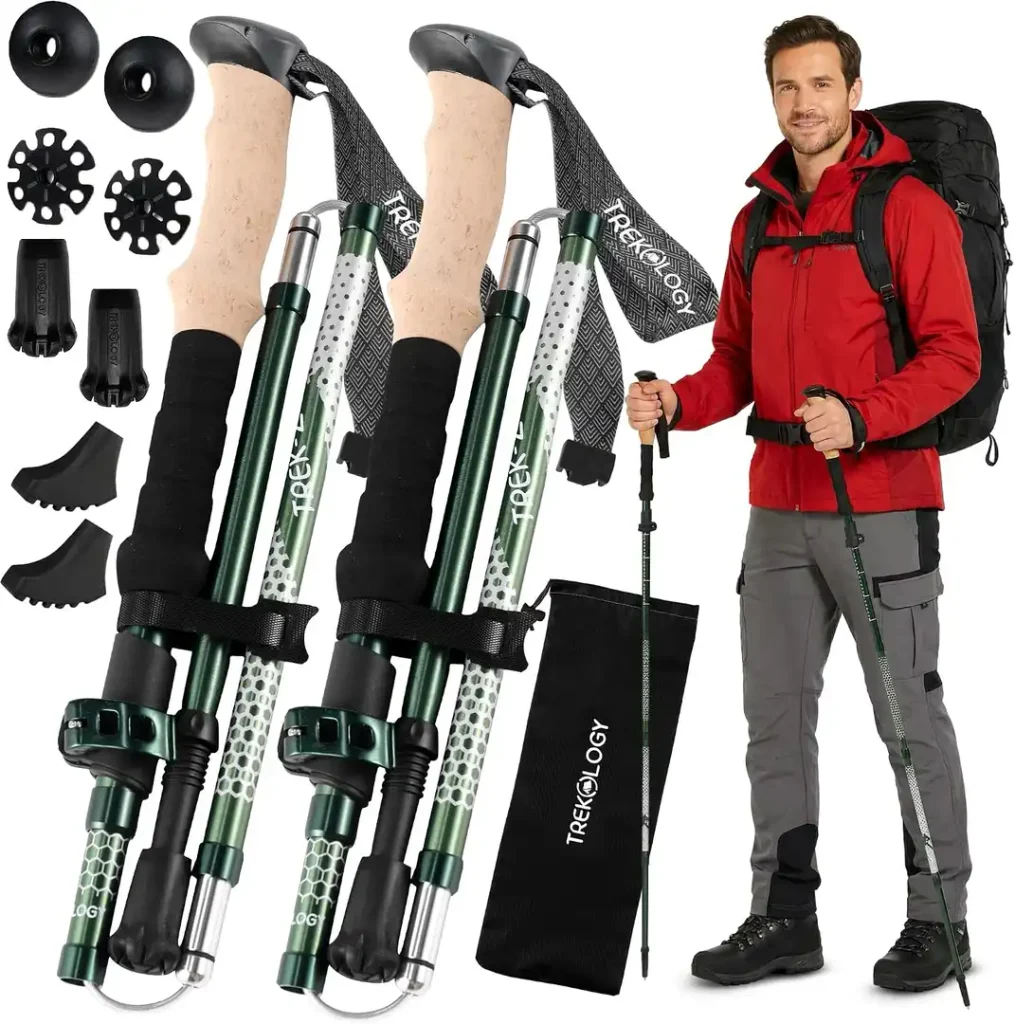
Best for: packable folding carry that rides a pack lid between scrambles.
- Folding five-section build: collapses to a short zipped bundle for stowage.
- Aluminum shafts: forgiving contact with the rocky ground the fold saves weight for.
- EVA foam grips: soft, warm, and quick-drying for all-day pushing.
- Fast flip locks: section tension set by lever rather than twist.
- An Amazon’s Choice listing: badge-carrying favorite with steady monthly takers.
Pros:
- The stash-and-go pair for travel and backup duty.
- Folding length straps to a daypack without a fight.
- Friendly entry into poles for family members who hike occasionally.
Cons:
- More joints means more points to check before a big descent.
- Firmness marginally softer than one-piece aluminum at full load.
- Folded bundle wants its bag to stay tidy.
Fold Up the Trekology on Amazon
6. Hiker Hunger Carbon Poles
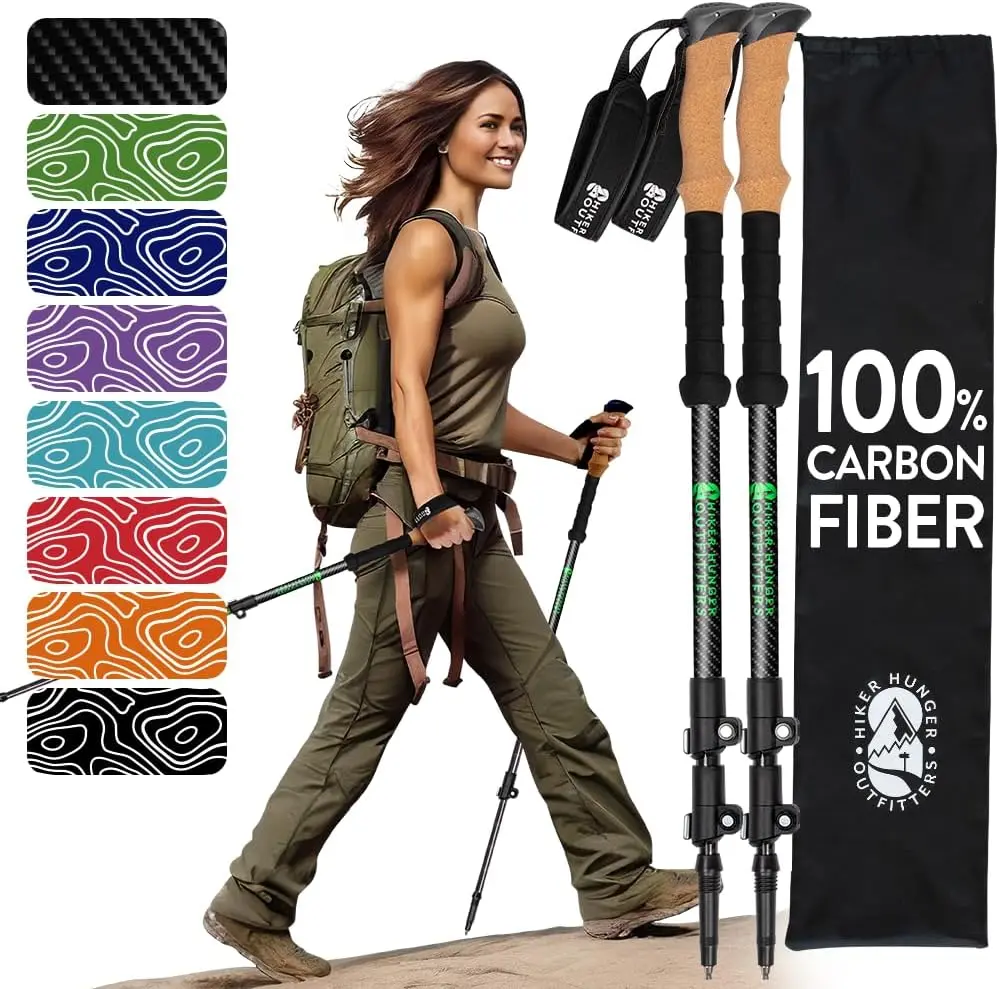
Best for: light carbon with a small-brand service line behind it.
- Full carbon fiber shafts: the lightest swing class on this page.
- Cork and EVA dual grips: shaped cork under palm, soft extension for choke-up.
- Flip locks with a light touch: adjust without wrestling the joint.
- Tungsten-carbide tips: replaceable contact that holds on ledges.
- Stateside small brand: a maker that answers its own mail, with an often-live coupon on the listing.
Pros:
- Feather swing that makes long ridgelines feel shorter.
- Dual-grip layout handles both cruise and steep pitch.
- A loyal following among walkers who log serious miles.
Cons:
- Stock ran thin at verification — check availability before planning around it.
- Carbon care applies: no prying under boulders.
- The coupon state shifts, so read the listing on the day.
Go Light with the Hiker Hunger on Amazon
7. LEKI Makalu FX Carbon Poles
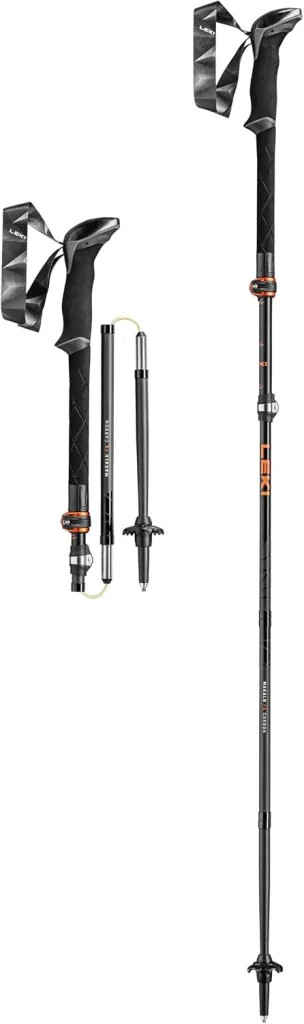
Best for: European folding carbon for serious mountain days.
- Speed Lock 2 Plus: the lever system tuned for instant, loaded adjustment.
- ELD folding system: the fold is guided, aligned, and positive rather than floppy.
- Aergon Air grip: the ergonomic top with an extended foam throat for steep work.
- Full carbon shaft: feather-class swing with the stiffness to plant hard.
- Ski-heritage hardware: the same lock family that races down pistes in winter.
Pros:
- The premium folding option that still feels like a full-length pole.
- Locking speed makes rolling rock a rhythm instead of a stop-and-set.
- Build polish you can feel at the first flick.
Cons:
- Offer lane can run slow to ship — check the delivery estimate before you commit.
- Top-shelf price brackets it with the Black Diamond rather than the value field.
- Folded sections want the storage bag to travel clean.
Ascend with the LEKI on Amazon
8. Cascade Mountain Tech Aluminum Poles

Best for: value aluminum with the extended-grip edge for steep ground.
- Extended down-grip: a second hold below the main grip for pitches that never ease.
- Aircraft-grade aluminum: the take-a-hit shaft spec at the friendliest entry here.
- Tip kit in the box: rubber feet and baskets swap for surface and season.
- Quick lever locks: fast, visible, and re-tightenable by hand.
- A huge following of its own: the second-largest readership on this page.
Pros:
- The most pair-for-the-money on the board.
- Extended grip earns its keep on long, knee-punishing descents.
- Accessory completeness matches the TrailBuddy at a lower bracket.
Cons:
- Swing weight tells on big vertical days versus carbon.
- Extended foam collects rain and dries slowly.
- Locks need an occasional quarter-turn of service.
Grip Down the CMT Aluminum on Amazon
Frequently Asked Questions
Q1: Carbon or aluminum poles for rocky ground — which holds up?
A: Both, with different failure styles. Aluminum dents and flexes under stone strikes, then keeps working; carbon swings lighter and quiets the rattle but can crack under a sharp sideways load. Rocky routes that eat gear argue for aluminum, while long mountain days with careful handling favor carbon.
Q2: Should I use rubber tips or bare carbide on rock?
A: Bare carbide grips best — it bites into seams and rough surfaces, which is exactly what you want on trail stone. Rubber feet quiet the pole, play well with slick slab and pavement approaches, and keep the carbide from gouging delicate rock. Many hikers run carbide on the trail and click rubber on for the drive home.
Q3: How long should my poles be for steep, rocky terrain?
A: Set them so your elbow bends at about ninety degrees on flat ground, then adjust with the grade: shorter for climbing so you can plant beside your feet, longer for descents so the pole reaches ahead of the landing. A pair with quick levers makes that dance a two-second habit.
Q4: Do wrist straps actually help, or are they a hazard?
A: They help on descents — the strap carries the hand so the grip stays relaxed and the pole keeps working even on a loose plant. Loosen them enough to slide free in a fall, and skip threading them through on scrambly ground where a dropped pole is safer than a tangled arm.
Q5: How do I travel with collapsible poles?
A: Fold or telescope them to their shortest, cap the tips, and bag them — the folded bundles slip into a checked bag or strap to a pack without snagging. Check your airline’s rules before flying, since tips count as pointy items in some cabins, and dry the poles before storage so the locks stay smooth.
Final Verdict
Rocky ground sorts good poles from lucky ones fast. The eight here cover the spread: forgiving aluminum for routes that batter gear, damped carbon for long descents, folding builds for the pack-lid commute, and a premium anchor for hikers who simply want the last pair they buy. Set the length for the grade, let the carbide find the seam, and let the poles carry what your knees used to.
If you want the best trekking poles for rocky terrain, the answer is already on this page — don’t overthink it—these are already:
✔ Shaft and tip claims follow each maker’s own listing.
✔ Lock styles and grip layouts match the live listings as they stand.
✔ Material and care details are described exactly as the makers intend them.
Best Overall: TrailBuddy Trekking Poles
Best Premium: Black Diamond Alpine Carbon Cork
Best Budget: Cascade Mountain Tech Aluminum Poles
Best Folding: LEKI Makalu FX Carbon Poles