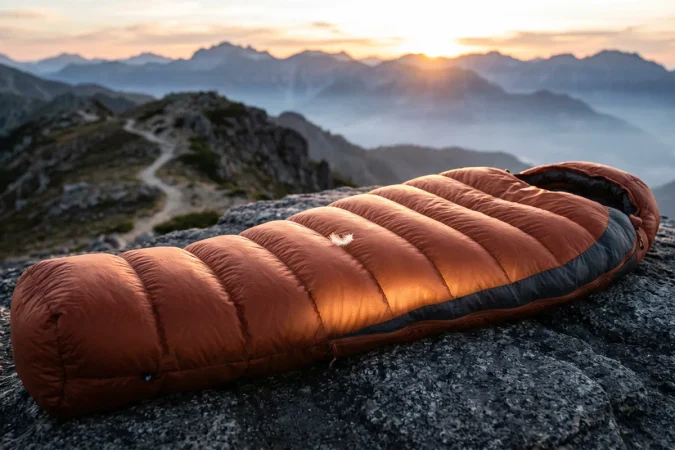
A thru-hike asks the same question every night: how much warmth has to be carried for the next twelve hours and the next twelve hundred miles. The best down sleeping bags for thru-hiking answer it with three numbers rather than a slogan — the temperature the maker prints, the weight of the fill, and the total weight of the bag that arrives in the box. Everything else, from the colour of the shell to the shape of the logo, is decoration on a piece of insulation that has to work in the rain, in a shelter, and on a ridge at two in the morning.
Fill power is the first number and the most misunderstood. It measures how much space an ounce of down occupies, so 850 fill power traps more air per ounce than 550 fill power and packs smaller for the same loft. That does not make a high-fill bag warmer on its own, because a bag with sixteen ounces of 850 down and a bag with twenty ounces of 650 down can hold similar loft. Read the fill weight beside the fill power, then read the total weight, which includes shell, zipper, baffles, draft collar and cord.
Construction decides whether that loft survives the night. Box baffles give the down a walled compartment and stop it migrating, while simple sewn-through seams create cold lines where the shell meets the lining. A draft tube behind the zipper and a collar around the neck are the difference between a warm bag and a bag with two cold channels running through it. Shell denier matters too, because a 10D fabric saves grams and a 20D fabric survives being dragged in and out of a pack for months.
Moisture and fit finish the decision. Down loses loft when it is soaked, so a shell with a durable water repellent finish, a treated fill and a dry sack are part of the system rather than accessories. A bag that is too short compresses the down at the foot and a bag that is too narrow fights every turn, which is why the length and girth figures matter as much as the temperature label. The best down sleeping bags for thru-hiking are the ones a hiker can climb into tired, with cold hands, in the dark, and still seal properly.
Quick Picks
Best Overall: Western Mountaineering Ultralite 20 — 1 lb 13 oz of bag around 16 oz of 850+ fill goose down with a 20°F label
👉 Carry the Western Mountaineering Ultralite on Amazon
Best Cold Weather: Sea to Summit Spark 0-Degree — a 0°F bag built on 850+ fill RDS down and a 10D shell
👉 Choose the Sea to Summit Spark on Amazon
Best Balance: Kelty Cosmic 20 — 550 fill RDS down and a 2 lb 6 oz total for a three-season walk
👉 Pack the Kelty Cosmic 20 on Amazon
Best for Women: Mountain Hardwear Bishop Pass 15F — a women’s cut in 650 fill down with a draft collar and a 20D shell
👉 Fit the Mountain Hardwear Bishop Pass on Amazon
Comparison Table
| Product Name | Best For | Price Range | Check Price on Amazon |
|---|---|---|---|
| Western Mountaineering Ultralite 20, 6 ft | Counting grams on a long trail | Premium | See the Western Mountaineering Ultralite |
| Sea to Summit Spark 0-Degree, Regular | Deep cold above the treeline | Premium | View the Sea to Summit Spark |
| Marmot Sawtooth 15, Standard | A tested label and a wide cut | Premium | Check the Marmot Sawtooth |
| Kelty Cosmic 20, Regular | Three seasons without a weight penalty | Mid | See the Kelty Cosmic 20 |
| Mountain Hardwear Bishop Pass 15F, Women’s | A women’s cut for shoulder seasons | Premium | View the Bishop Pass |
| MOUNTAINTOP 650 Fill Duck Down, 32 Degree | A first down bag for a tight kit | Budget | Check the MOUNTAINTOP bag |
| ATEPA 700FP, Black | Milder nights and a light pack | Mid | See the ATEPA 700FP |
Buyer’s Guide
1. Read the Temperature Label Before Anything Else
Most bags sell on a single number, and that number is usually the limit rather than the comfort figure. A limit describes the coldest temperature at which a strong sleeper stays merely not cold, while comfort describes the temperature at which an average sleeper rests without curling up. A bag labelled 20°F and rated to an ISO limit of 21°F is a three-season bag for most people, not a winter bag. Read both figures when a maker publishes them, and treat the lower one as the edge of the envelope rather than the middle of it.
2. Compare Fill Power Beside Fill Weight
Fill power tells you how much space an ounce of down occupies, so 850 fill power packs smaller than 550 for the same warmth. It says nothing about how much down is in the bag. Two bags with the same fill power can differ by half a pound of fill, and the total weight figure includes the shell, the zipper, the baffles and the cord. Weigh the three numbers together and the real comparison appears, which is why a modest fill figure in a well-built bag can beat a high one in a thin shell.
3. Check the Cut, the Girth and the Baffles
A mummy bag saves weight by narrowing at the shoulders and the feet, and that cut only works if the girth fits the sleeper. Check the shoulder and foot measurements against the width of the user, then check the maximum height the size is built for. Inside the bag, box baffles hold down in place and sewn-through seams create cold lines, so the construction matters as much as the loft. A draft tube behind the zip and a collar at the neck close the two gaps a warm bag still loses heat through.
4. Plan for Moisture on a Long Trail
Down loses its loft when it takes on water, and a thru-hike guarantees condensation, rain and the occasional wet shelter floor. A shell with a durable water repellent finish sheds light rain, a treated fill such as Ultra-Dry or Down Defender slows the absorption, and a dry sack or a pack liner protects the bag when the weather turns. Air the bag every morning before it goes into the pack, and never store it compressed between trips. A bag kept dry for three months still lofts like new.
One Mistake to Avoid: Buying for the Coldest Night Instead of the Average One
The classic error is buying a bag for the worst night of the trip, which usually means a warmer and heavier bag than the route ever needs. A 0°F bag carried through a summer season is a pound of down that has to be hauled over every pass, and it is often too warm to sleep in comfortably. Read the conditions for the weeks the hike actually covers, add a margin of about ten degrees for a cold sleeper, and spend the saved weight on a better pad. The pad is half of the sleep system.
7 Best Down Sleeping Bags for Thru-Hiking That Keep Long-Distance Backpackers Warm Without Extra Weight
These seven bags run from a 1 lb 13 oz mummy with 850+ fill down to a 0°F bag built for deep cold, and the spread is deliberate, because a thru-hike in July and a thru-hike that starts in March do not need the same insulation. Each entry leads with the fill power, fill weight, temperature label and total weight published for the product, then says where the design stops working. The order follows the list supplied for this round, so read it as a comparison rather than a ranking. Where a maker leaves a figure out, or the page contradicts itself, that gap is stated instead of filled in.
1. Western Mountaineering Ultralite 20 Degree Sleeping Bag, 6 ft, Right Zip
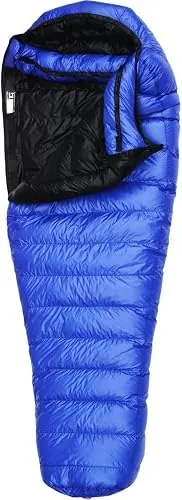
Best for: A thru-hiker who counts every ounce and wants a 20°F bag that stays under two pounds.
- 1 lb 13 oz Total Weight: The figure for the 6 ft bag, light enough to justify on a long resupply schedule.
- 16 oz of 850+ Fill Down: Goose down at 850 fill power or better, the highest fill figure in this group.
- 5 in Loft, 20°F Label: The loft the maker prints beside the temperature the bag is built for.
- 59 in Shoulder, 38 in Foot Girth: The girth measurements, a narrow mummy cut that saves fabric and weight.
- 5 1/4 in Continuous Baffles: Baffles running zipper to zipper, so down can be shifted toward the chest or the feet.
Pros:
- The weight is close to the floor for a genuine 20°F down bag.
- Continuous baffles let a sleeper move warmth where the night demands it.
- The shell is breathable enough to cut condensation inside a small tent.
Cons:
- The narrow cut leaves little room for a restless side sleeper.
- One size and one colourway limit the fit for anyone under six feet.
- The bag is built light rather than tough, so it needs a liner in a pack.
Tuck the Western Mountaineering Ultralite on Amazon
2. Sea to Summit Spark Ultralight Down Sleeping Bag, 0-Degree, Regular
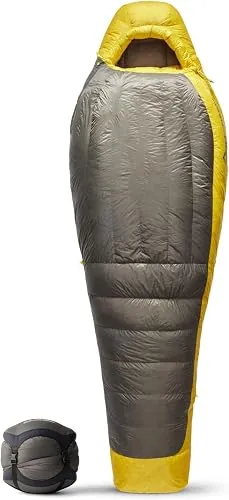
Best for: A hiker walking a late-season section who expects nights well below freezing.
- 0°F (-18°C) Label: The coldest temperature figure in this group, aimed at deep winter and high camps.
- 850+ Fill RDS Down: Responsible Down Standard certified down with a non-PFC Ultra-Dry treatment.
- 10D Shell and Liner: A very light fabric with a PFC-free DWR on the hood and footbox, closed with a #5 YKK zip.
- Full Box Baffles: Continuous compartments from hood to footbox rather than sewn-through seams, built to hold loft through a 0°F night.
- Weight Not Published: The page carries no packed or total weight for this size, so the figure has to be confirmed before a long carry.
Pros:
- The temperature label covers nights that would sideline most three-season bags.
- The treated down keeps its loft longer in damp, cold conditions.
- A contoured cut leaves room to move without adding much fabric.
Cons:
- The 10D shell needs careful handling around velcro, zips and shelter floors.
- Without a published weight there is no way to plan the base weight from the page.
- The bag is overbuilt for summer use, where its warmth becomes a burden.
Zip the Sea to Summit Spark on Amazon
3. Marmot Men’s Sawtooth 15° Sleeping Bag, Standard
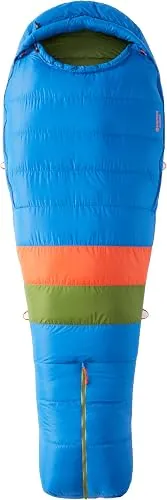
Best for: A backpacker who wants a tested temperature label and a wider cut than a racing mummy.
- 650 Fill Power Down: Certified down treated with Down Defender to slow moisture uptake.
- 15°F ISO-Tested Label: The temperature figure the maker lists, tested to a published standard.
- 1,310 g (2 lb 14 oz): The listed weight of the standard bag, heavier than the ultralight options here.
- 72 x 32 in: The listed length and width, with a maximum height recommendation of 183 cm.
- 2 Side Zippers and a Footbox Zip: Dual zips with extended flaps, plus a footbox that opens for extra space.
Pros:
- The wider cut suits sleepers who roll over and hate a tight mummy.
- Dual side zippers let the bag open flat like a quilt on warm nights.
- A storage sack and a stuff sack both come in the box.
Cons:
- At 1,310 g it is a pound heavier than the lightest bag here.
- The 650 fill packs larger than the 850 fill options in the same range.
- The standard size stops at six feet, which rules out taller hikers.
Sling the Marmot Sawtooth on Amazon
4. Kelty Cosmic 20 Down Mummy Sleeping Bag, Regular
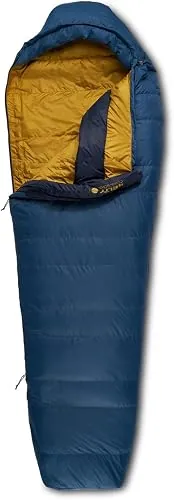
Best for: A three-season thru-hiker who wants a proven down bag without paying for the last few grams.
- 550 Fill Power RDS Down: Traceable down certified to the Responsible Down Standard.
- ISO 21°F Limit, -11°F Extreme: The tested figures printed for the bag, against a 20°F product title.
- About 2 lb 6 oz: The total weight Kelty gives for the regular size.
- 13 x 7 in Stuffed: The packed size with the supplied stuff sack.
- 20D Nylon Shell, 50D Polyester Liner: Recycled fabrics finished with a PFC-free DWR and no PFAS.
Pros:
- The price of entry is the lowest of the down bags here relative to its warmth.
- Dual-direction zippers vent heat without opening the whole bag.
- Three lengths cover sleepers from five foot six to six foot six.
Cons:
- The 550 fill down is bulkier in a pack than any 800 fill bag.
- Two and a quarter pounds is a real tax on a long resupply carry.
- The 20°F label describes a limit, not a comfortable night at that temperature.
Roll the Kelty Cosmic 20 on Amazon
5. Mountain Hardwear Bishop Pass 15F Down Sleeping Bag, Women’s Regular, Right Zip

Best for: A woman hiking shoulder seasons who wants insulation mapped for a smaller frame.
- 650 Fill Power Down: The fill the maker lists, warmer per gram than the 550 fill bags here.
- 15°F (-9°C) Label: The listed temperature for the bag, aimed at cold shoulder-season nights.
- 20D Ripstop Nylon Shell: An abrasion-resistant face fabric with a DWR finish.
- 2-Way Zipper with Draft Guard: A full-length zip with a guard behind it, plus a draft collar at the neck.
- Fits to 5 ft 8 in: The maximum height for the regular length in this women’s cut.
Pros:
- Extra fill is placed where a smaller sleeper loses heat fastest.
- The ripstop shell takes abrasion that a 10D fabric would not survive.
- The draft collar and guard close the two gaps that wake cold sleepers.
Cons:
- The page weight field conflicts with other published figures, so there is no dependable number to plan around.
- The regular length stops at five foot eight, so taller women need another size.
- At this outlay the bag is a commitment rather than a first purchase.
Compress the Bishop Pass on Amazon
6. MOUNTAINTOP Ultralight Mummy Down Sleeping Bag, 32 Degree, Blue
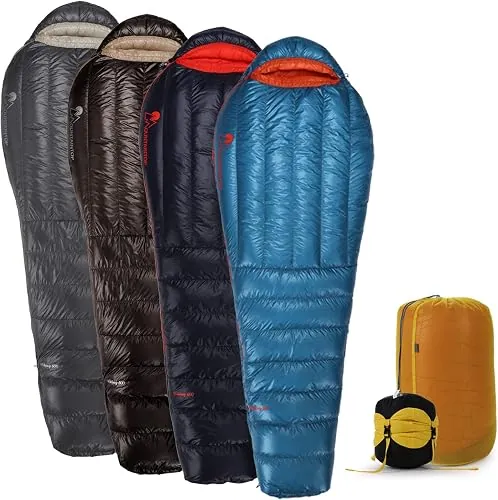
Best for: A newer backpacker building a first down kit for summer trips and mild shoulder nights.
- 600 g Duck Down: The fill quantity listed for the bag, in duck down rather than goose.
- 1,120 g (2.46 lb) Total: The complete weight of the bag as sold.
- 650 Fill Power: The fill figure printed on the page, mid-range among the bags here.
- 20°F Lower Limit, 10°F Extreme: The maker’s lower and extreme figures, with comfort listed from 32°F to 50°F.
- 9.5 x 7 in Compressed: The packed size, in a shell of 20D 420T ripstop nylon.
Pros:
- The comfort range covers summer nights without excess insulation.
- A leg zipper lets a hot sleeper vent the feet without opening the bag.
- The quick-release compression sack makes packing in the morning fast.
Cons:
- Duck down and a 2.46 lb total make this a load rather than a racing bag.
- The temperature spread from 32°F comfort to a 20°F limit is wide enough to mislead.
- The shell is thin enough that a shelter floor will find every sharp edge.
Snug the MOUNTAINTOP bag on Amazon
7. ATEPA 700FP Down Backpacking Sleeping Bag, Black
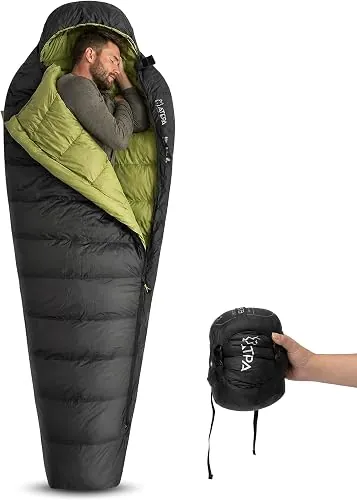
Best for: A summer thru-hiker on a light pack who sleeps warm and wants a roomy mummy.
- 700 Fill Power RDS Down: Certified down with a moisture-resistant treatment the maker calls COLDMASTER.
- 2.2 lb Total: The listed weight, light for the length and width on offer.
- 34°F Limit, 43°F Comfort: The ISO figures in the specification, with the product title rounding the limit to 35°F.
- 15D Recycled Nylon Shell: A GRS-certified recycled shell and a 20D nylon liner.
- 86.6 x 31.5 in, Fits to 6 ft 5 in: A long, wide cut that packs to 13.8 x 7.5 in.
Pros:
- The cut fits tall sleepers who are squeezed by a standard mummy.
- The 2.2 lb total is light for a bag this long.
- A two-way zip and a draft collar make venting and sealing easy.
Cons:
- A 34°F limit makes this a summer bag, not a three-season one.
- The title, colour label and specification quote three slightly different limit figures.
- The 15D shell trades durability for weight in a way that shows after a season.
Settle into the ATEPA 700FP on Amazon
Frequently Asked Questions
Q1: What should I look for in the best down sleeping bags for thru-hiking?
A: Start with the temperature label and decide whether it describes a limit or a comfort figure, because a 20°F limit is not a comfortable night at 20°F for most sleepers. Then read the fill power beside the fill weight, since 850 fill power in a thin bag can be less warm than 650 fill with more down in it. Check the total weight, the packed size and the girth against the sleeper. Finish with the shell denier, the draft collar and the zipper, which decide how the bag behaves on a wet, windy night.
Q2: What is the difference between a comfort and a limit temperature?
A: A comfort figure describes the temperature at which an average sleeper stays comfortable through the night, while a limit figure describes the coldest temperature at which a strong sleeper stays merely not cold. Makers often print the limit because it flatters the bag. If only one figure is shown, assume it is the limit and add roughly ten degrees for a cold sleeper or for an older sleeper. A bag sold as 20°F is a three-season bag for most people, not a winter bag.
Q3: Does higher fill power always mean a warmer bag?
A: No, because fill power measures how much space an ounce of down occupies rather than how much down the bag contains. An 850 fill bag with a modest fill weight can hold less loft than a 650 fill bag stuffed with more down. Fill power does tell you how small the bag packs for a given warmth, which matters on a long carry. Read the fill weight and the total weight together, and treat a high fill figure without either as an incomplete specification.
Q4: How do I keep a down bag dry on a long trail?
A: Treat the bag as the one item that cannot get wet, because down that soaks loses the loft that makes it warm. Use a waterproof pack liner or a dry sack rather than trusting a pack cover in steady rain, and keep the bag at the top of the pack so it comes out before anything else in a wet shelter. Air it every morning, dry it in the sun at resupply when possible, and never store it compressed at home. A treated fill and a water-repellent shell buy time, not immunity.
Q5: How much warmer do I need to go for a cold sleeper?
A: A cold sleeper usually wants about ten degrees more insulation than the label suggests, or a bag aimed at a lower comfort figure rather than the limit. Add a warmer pad underneath before buying a hotter bag, because most heat is lost downward and a pad with more insulation underneath adds less weight than another pound of down. A liner adds a few degrees and keeps the bag clean. Fit matters too: a bag that is too short or too narrow loses warmth at the extremities.
Final Verdict
The right bag depends on when the hike starts and how much the sleeper feels the cold. The Western Mountaineering Ultralite puts 16 oz of 850+ fill down into a 1 lb 13 oz bag, the Sea to Summit Spark carries a 0°F label for deep cold, and the Kelty Cosmic 20 balances 550 fill RDS down against a 2 lb 6 oz total for three-season use. The Mountain Hardwear Bishop Pass shapes 650 fill down around a smaller frame, while the MOUNTAINTOP and ATEPA bags cover milder nights and long frames at the other end of the group.
If you want the best down sleeping bags for thru-hiking that hold their loft night after night without weighing down the pack, don’t overthink it—these are already:
✔ Every fill power, fill weight and temperature figure is the one published for the product
✔ Gaps in the published data are stated rather than filled with an estimate
✔ Limit and comfort labels are kept apart wherever a maker gives both
Best Overall – Western Mountaineering Ultralite 20 Degree Sleeping Bag, 6 ft, Right Zip
Best Cold Weather – Sea to Summit Spark Ultralight Down Sleeping Bag, 0-Degree, Regular
Best Balance – Kelty Cosmic 20 Down Mummy Sleeping Bag, Regular
Best for Women – Mountain Hardwear Bishop Pass 15F Down Sleeping Bag, Women’s Regular, Right Zip