
A dry bag earns its place the moment a trail crosses a stream or a kayak takes spray over the bow, and the best dry bags for hiking and kayaking are judged on how the shell, the seams and the closure behave once the bag is wet rather than on how tidy it looks on a shelf. A sack that weeps at the base, or that pops a buckle in a capsize, has failed at the only job it had. Everything else — colour, logo, the shape of the handle — is decoration.
Fabric comes first. Denier measures the weight of the yarn in the weave, so a 500D PVC shell is heavy, stiff and abrasion-resistant while a 210T polyester or 190D ripstop sack is thin, quiet and folds into a fist. Neither is better in the abstract. A bag that rides a boat deck and gets dragged over gravel needs the thick shell, and a bag that lives in a hiking pack needs the light one, because the strongest fabric in the world is no use if it is left at home. Seams decide whether that fabric holds: welded seams fuse two coated panels into one surface, taped seams cover the stitch line with a waterproof strip, and a plain sewn seam under a sprayed coating is the weakest of the three.
The closure is where most dry bags quietly stop being dry. A roll-top works by folding the mouth over itself until the opening is sealed and then clipping the buckle ends together, and three folds is the practical minimum for most sacks. Fold it flat, keep the buckles centred, and leave a little air inside so the fabric has something to press against. Read the submersion wording too, because a sack rated for spray and a sack rated for a dunking are different products, and several makers state plainly that their bag should not be kept underwater.
Carry and buoyancy finish the decision. A single shoulder strap is fine on a short portage and punishing on a long approach, while backpack straps spread a loaded bag across both shoulders. A roll-top that traps air will float when it is sealed and not overloaded, which is why a round or rectangular base matters more than a printed litre count. Before the season starts, fill the bag with a towel, seal it, and hold it under the bath for a minute; the best dry bags for hiking and kayaking are the ones that pass that test in the kitchen rather than the ones that look most convincing in a shop.
Quick Picks
Best Overall: Earth Pak Waterproof Dry Bag, 20L — a 500D PVC roll-top with an IPX8 phone case and a five-year warranty for trips that mix trail and water
👉 Choose the Earth Pak 20L on Amazon
Best for Paddling: MARCHWAY Floating Waterproof Dry Bag, 10L — a round base that traps air and floats, with a shoulder strap that leaves both hands free
👉 Grab the MARCHWAY 10L on Amazon
Best Multi-Bag Set: Frelaxy Dry Bag 5-Pack — five sacks from 3L to 20L that sort a whole group’s gear by size and colour
👉 Order the Frelaxy five-pack on Amazon
Best Ultralight: Osprey Ultralight Waterproof Dry Sack, 6L — a 0.07 lb sack that disappears into a day pack and shrugs off rain and spray
👉 Pick the Osprey 6L sack on Amazon
Comparison Table
| Product Name | Best For | Price Range | Check Price on Amazon |
|---|---|---|---|
| HEETA Dry Bag Waterproof Backpack with Phone Case, 5L | See-through waterproofing for small kit | Budget | See the HEETA 5L bag |
| Earth Pak Waterproof Dry Bag, 20L | One bag for trail and boat | Mid | View the Earth Pak 20L |
| Frelaxy Dry Bag 5-Pack, 3L to 20L | Sorting a group’s gear by size | Mid | Check the Frelaxy five-pack |
| Wise Owl Outfitters Waterproof Dry Bag 3-Pack | Three sizes for camp and boat | Mid | See the Wise Owl three-pack |
| MARCHWAY Floating Waterproof Dry Bag, 10L | A floating bag for short crossings | Budget | View the MARCHWAY 10L |
| Unigear Floating Waterproof Dry Bag, 2L | A phone and keys on the water | Budget | Check the Unigear 2L |
| Sunnylon Dry Bag Backpack, 20L | Wet and dry kit kept apart | Mid | See the Sunnylon 20L |
| STOVER Waterproof Dry Backpack, 30L | Overnight gear on a wet deck | Premium | View the STOVER 30L |
| Osprey Ultralight Waterproof Dry Sack, 6L | Rain and spray in a day pack | Mid | Check the Osprey 6L |
Buyer’s Guide
1. Match the Shell to the Water You Expect
Denier describes the yarn in the weave, not the thickness of the finished bag, so a 210T polyester sack and a 500D PVC sack answer different questions. The heavier shell resists abrasion and holds its shape, which suits a boat deck, a raft floor or a bag that gets dragged across gravel. The lighter shell folds small and disappears into a hiking pack, but it will not survive the same abuse. Pick the fabric for the worst surface the bag will meet, not for the printed litre count.
2. Look at the Seams Before the Shell
A waterproof fabric is only as dry as the lines where it is joined. Welded seams fuse two coated panels into a single surface, and taped seams cover the stitch line with a waterproof strip, while a plain sewn seam under a sprayed coating is the weakest option of the three. Check the base especially, because the floor takes the most abrasion and the most standing water. A sack with a welded base and a taped roll-top will outlast one that only claims a waterproof finish.
3. Roll the Top the Way the Maker Intended
A roll-top seals by folding the mouth over itself and clipping the two buckle ends together, and the number of folds matters more than the force applied. Three folds is the practical minimum for most sacks, while some makers ask for five and others for three or four. Fold the fabric flat rather than crumpled, keep the buckles centred, and leave a hand’s width of air inside so the closure has something to press against. A roll-top folded once and clipped is an open bag with extra steps.
4. Choose the Carry System for the Approach
A small sack with one shoulder strap is comfortable on a short portage and punishing on a two-hour walk, because the load hangs off one side of the body. Backpack straps spread the weight across both shoulders, and a sternum strap keeps the bag from swinging when the trail turns rough. Sizes above thirty litres usually earn those straps, while smaller sacks stay light enough for cross-body carry. Match the harness to the longest walk between the car and the water, not to the shortest one.
One Mistake to Avoid: Expecting a Roll-Top to Survive a Swim
The most common failure is treating a splash-proof sack as a submarine. A roll-top keeps rain and spray out, and several makers state plainly that the bag should not be kept underwater, while one product here is built to a splash standard and says so. Air trapped inside gives buoyancy, but buoyancy is not a seal. If the plan includes swimming a rapid or lashing gear to a deck in surf, choose a bag with a stated submersion limit, dry it fully afterwards, and keep a phone in a case rated for pressure rather than loose in a pocket.
Best Dry Bags for Hiking and Kayaking: 9 Waterproof Options for Outdoor Enthusiasts Who Need Reliable Gear Protection
These nine sacks run from a 2L pouch that clips to a belt to a 30L pack built for a wet deck, and the spread is deliberate, because hiking and paddling ask different things of the same closure. Each entry leads with the capacity, shell, seam construction and carry hardware listed for the product, then says where the design stops working. The order follows the list supplied for this round, so read it as a comparison rather than a ranking. Where a maker states a submersion limit, that limit is repeated here rather than softened.
1. HEETA Dry Bag Waterproof Backpack with Phone Case, 5L, Transparent Blue
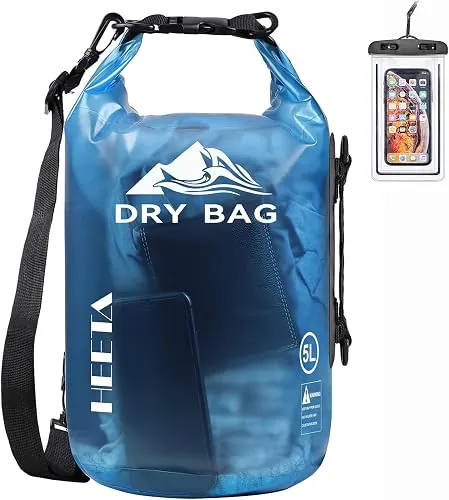
Best for: A hiker who wants to see what is inside the bag without opening it and keep a phone sealed in the same purchase.
- 5L Capacity: The smallest size in a line that runs to 40L, enough for a phone, keys, a wallet and a light layer.
- 0.6 mm Base, 0.3 mm Sides: The PVC wall thickness at the floor and along the body, heavier where the bag meets the ground.
- 5 Sizes: 5L, 10L, 20L, 30L and 40L share the same transparent shell.
- 11 Colors: The clear finish is offered in eleven colourways, so kit stays visible through the wall whatever the shade.
- 1 Phone Case Included: A touch-screen compatible waterproof case ships with the bag.
Pros:
- The clear wall lets you find a headtorch or a dry layer without unpacking the whole bag.
- Straps and a side handle cover a short walk or a hand carry equally well.
- A phone case in the box removes one separate purchase from the kit list.
Cons:
- The 5L shell takes a layer and a phone but not a full day of food and clothing.
- Clear PVC shows every scuff, grit line and crease after a season of use.
- The strap edges are thin once the bag is loaded for a long walk.
2. Earth Pak Waterproof Dry Bag, 20L, Forest Green
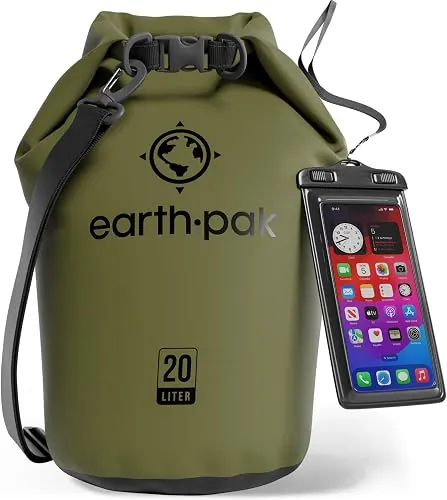
Best for: A paddler who wants one bag for the boat and the trail, with a sealed phone and a warranty behind the shell.
- 20L Capacity: The mid size in a line that starts at 5L and finishes at 55L.
- 500D PVC Shell: The abrasion-resistant fabric listed for the bag, a heavy gauge suited to boat decks.
- 1 IPX8 Phone Case: A dual-window case rated IPX8 that fits phones up to 6.5 in.
- 24–42 in Shoulder Strap: The adjustable strap supplied with the 10L and 20L sizes for cross-body carry.
- 5-Year Warranty: The coverage term the maker publishes for the bag.
Pros:
- The thick shell shrugs off gravel, deck rash and the rub of a pack frame.
- The phone case is built for immersion rather than spray alone.
- A five-year warranty backs a bag that is expected to be used hard every season.
Cons:
- At 20L it rides on one shoulder, so a full bag swings on a steep climb.
- One compartment means wet paddling kit shares space with dry clothing.
- The case windows haze over after months of pocket carry.
Pack the Earth Pak 20L on Amazon
3. Frelaxy Dry Bag 5-Pack, 3L to 20L, Assorted Colors
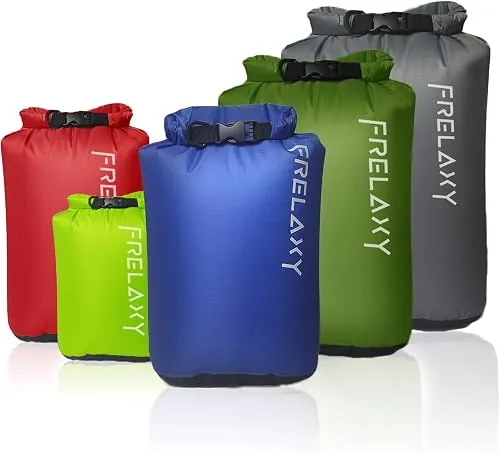
Best for: A group or a family that wants one order to cover food, layers and electronics in separate sacks.
- 5 Sacks, 3L to 20L: One each of 3L, 5L, 10L, 15L and 20L in five different colours.
- 210T Tear-Resistant Polyester: The fabric listed for the set, a light weave rather than a PVC shell.
- 35 g to 60 g: The listed weight of each sack, from the 3L at 35 g to the 20L at 60 g.
- Fully Taped Seams: A taped seam line inside the closure, the construction listed for the set.
- 1 D-Ring Per Sack: A clip point for hanging a sack off a boat or the outside of a pack.
Pros:
- Five sacks let a group split food, layers and electronics by size instead of guessing.
- The weights disappear into a pack, so a spare sack adds almost nothing to the load.
- Different colours make a sack identifiable inside a shared tent.
Cons:
- The light fabric will not survive being dragged over rock or gravel.
- The set is built for splash and rain rather than a dunking.
- Five loose sacks need a system to stay together in a crowded pack.
Sort the Frelaxy five-pack on Amazon
4. Wise Owl Outfitters Waterproof Dry Bag 3-Pack, 5L, 10L and 20L
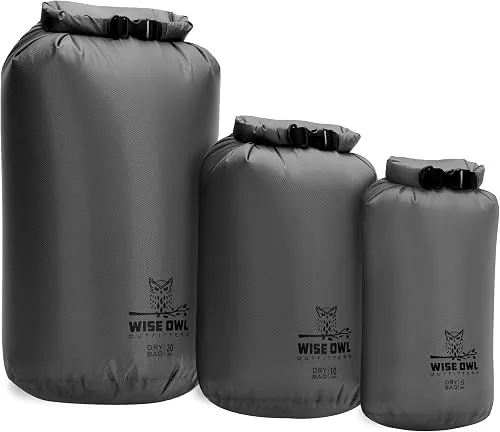
Best for: A hiker who wants a sack for the pack, one for the boat hatch and one for camp without shopping twice.
- 3 Sacks, 5L, 10L and 20L: A small, medium and large set that covers most of a day’s kit.
- 190D Ripstop Nylon: A diamond ripstop weave with a water-resistant coating, the fabric listed for the set.
- 16 x 6 in to 22 x 9 in: The listed footprint of the range, with the 10L sack at 17 x 8 in.
- 1 D-Ring and Buckle Clip: A clip point for lashing the bag to a boat, a pack or a paddle.
- Floats When Sealed Properly: A water-resistant sack that stays on the surface if it is dropped in.
Pros:
- Three sizes cover a day pack, a boat hatch and a camp kit in one order.
- The ripstop shell packs smaller and quieter than a PVC bag.
- The roll-top and clip close with wet hands and gloves on.
Cons:
- The woven shell is the lightest here and needs care around sharp edges.
- There are no backpack straps, so a full 20L hangs from one hand.
- Grey is hard to pick out on a boat deck at dusk.
Organize the Wise Owl three-pack on Amazon
5. MARCHWAY Floating Waterproof Dry Bag, 10L, Teal
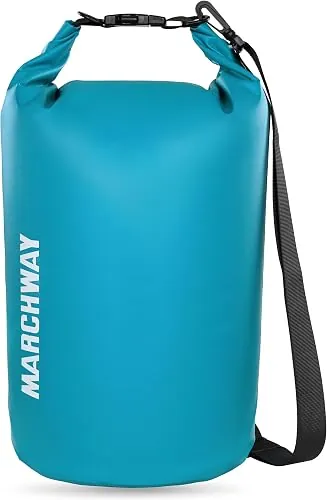
Best for: A paddler who wants a bag that rides the surface after a capsize and carries across the body on a portage.
- 10L Capacity: The middle of a line that runs from 5L to 40L, sized for a day’s clothing and lunch.
- 3 to 5 Rolls: The roll-top closure needs three to five folds before the buckle closes, the maker’s stated procedure.
- 1 Shoulder Strap: An adjustable, removable strap on the 5L and 10L sizes for cross-body carry.
- 20L to 40L Backpack Straps: The three largest sizes ship with backpack straps for even weight distribution.
- 1 D-Ring: A reinforced lash point for tying the sack to a boat or a pack.
Pros:
- The round base traps air, so the bag rides high and stays visible if it goes overboard.
- The shoulder strap comes off for a boat and goes back on for the walk in.
- The multi-layer shell takes scrapes that would wear through a lighter sack.
Cons:
- The 10L size leaves no room for overnight kit.
- One strap across the body is tiring on a long approach with a full bag.
- The maker rules out extended submersion, so a swim is still a risk.
Strap the MARCHWAY 10L on Amazon
6. Unigear Floating Waterproof Dry Bag, 2L, Yellow
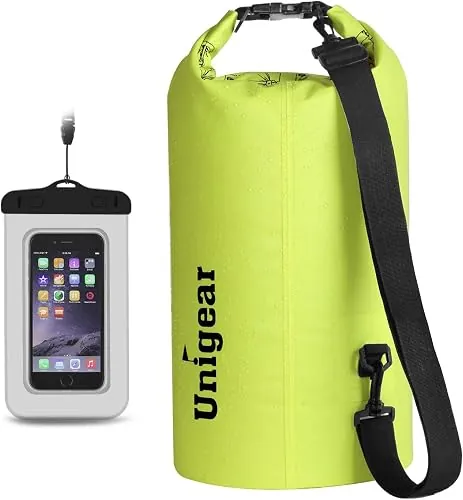
Best for: A paddler who wants a phone, keys and a wallet sealed in a bag that clips to a belt or a deck line.
- 2L Capacity: The smallest size in a line that runs from 2L to 40L.
- 500D PVC Shell: A stiff, abrasion-resistant fabric that holds its shape when the bag is empty.
- 6 Sizes: 2L, 5L, 10L, 20L, 30L and 40L, plus a three-pack of the 2L.
- 1 POM Buckle and D-Rings: Upgraded hardware that the maker describes as stronger than a standard buckle.
- 1 Phone Case Included: A waterproof phone case ships with the bag.
Pros:
- The 2L size clips to a belt or a deck line and keeps small valuables together.
- The stiff shell stands open while you load it, which matters with cold hands.
- Welded seams and the upgraded buckle take knocks without loosening.
Cons:
- Two litres will not take a spare layer or a lunch.
- The stiff fabric is awkward to compress into a small pocket.
- The bright shell shows dirt and sand quickly.
Slide the Unigear 2L on Amazon
7. Sunnylon Dry Bag Backpack, 20L, Green
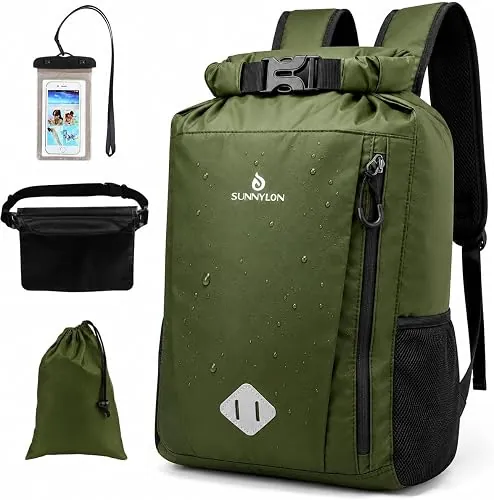
Best for: A paddler who ends the day with wet kit and wants it kept away from the dry clothing in the same bag.
- 20L Capacity: A single size with enough room for a day’s clothing, food and a camera.
- 3 Pieces Per Order: The backpack, a waist pouch and an IPX8 waterproof phone case ship together.
- 2 Compartments: A waterproof main bag plus a front zip pocket for wet clothes or a towel.
- IPX8 Phone Case: A sealed case for the handset, carried separately from the dry compartment.
- Floats When Closed: The bag is built to stay on the surface if it ends up in the water.
Pros:
- The front pocket separates wet kit from dry clothing without a second bag.
- The waist pouch and phone case mean nothing extra to buy before the first trip.
- Backpack straps make the walk from car to water comfortable.
Cons:
- The extra zip and pocket add seams that need checking before each trip.
- It comes in one capacity, which is too large for a short afternoon and small for a weekend.
- The front pocket is the last place for anything that must stay dry.
Stow the Sunnylon 20L on Amazon
8. STOVER Waterproof Dry Backpack, 30L, Purple
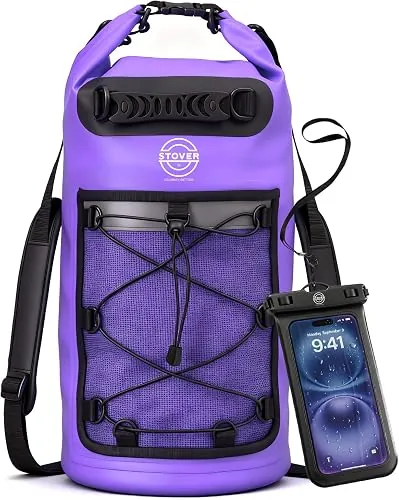
Best for: A kayaker carrying overnight kit who wants a bag that switches between backpack, cross-body and hand carry.
- 30L Capacity: The middle of a 5L, 10L, 25L, 30L and 40L range, big enough for a light overnight load.
- 3 Carry Modes: Two straps as a backpack, one strap across the body, or the top handle at your side.
- 3 to 4 Rolls: The maker’s instruction for closing the roll-top before the buckles are fastened.
- 6.5 x 3.2 in Phone Case: An IP58 case that takes phones up to that size, with a lanyard and touchscreen window.
- 1 Reflective Strip: A reflective band on the front pocket for visibility in low light.
Pros:
- Backpack straps and a padded back make a loaded bag easy to move between car and water.
- The wet and dry pocket keeps a towel away from clothing that has to stay dry.
- The reflective strip and bright colourway make the bag easy to spot on a grey day.
Cons:
- A full 30L sack is the heaviest load to carry in this group.
- The extra pocket and straps add bulk at the front of the bag.
- The reflective strip sits on the pocket, so it disappears under a stuffed load.
Shoulder the STOVER 30L on Amazon
9. Osprey Ultralight Waterproof Dry Sack, 6L, Waterfront Blue
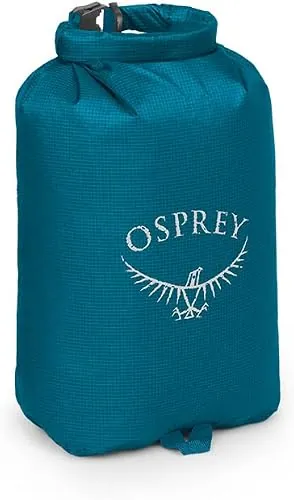
Best for: A day hiker or paddler who wants a real dry sack in the pack and does not want to notice the weight of it.
- 6L Capacity: Room for a layer, a lunch and a small camera, sized for a day pack rather than a boat hold.
- 0.07 lb: The listed item weight, lighter than any other single sack stated in this group.
- 11.4 x 7.1 x 5.5 in: The listed dimensions, a rectangular shape that packs flat against a pack wall.
- IPX5 Waterproof: The splash standard the bag meets, with the maker stating that it is not submersible.
- 1 D-Ring: A loop for hanging the sack to dry or attaching it inside a pack.
Pros:
- The sack weighs almost nothing, so it lives in a day pack without being noticed.
- The rectangular cut packs against a pack wall instead of rolling into a lump.
- The coated fabric and seams shed rain and paddle spray without a cover.
Cons:
- The splash standard rules out a swim or a submerged crossing.
- Six litres will not take a sleeping bag or a full change of clothing.
- The thin fabric needs care around tools and sharp edges.
Clip the Osprey 6L sack on Amazon
Frequently Asked Questions
Q1: What should I look for in the best dry bags for hiking and kayaking?
A: Start with capacity and the job: 2L to 6L holds a phone, keys and a light layer, 10L to 20L takes a day’s clothing and food, and 30L and up is overnight kit or boat storage. Then check the shell and the seams, since a 500D PVC sack survives abrasion that a 210T polyester sack will not. Read the closure and any submersion limit next, and decide between a shoulder strap and backpack straps. Included phone cases and pouches count in the total, because they replace two separate purchases.
Q2: Is a 500D PVC dry bag better than a 210T polyester one?
A: Neither is better in every case, because they trade weight against toughness. A 500D PVC shell is heavy, stiff and abrasion-resistant, which suits kayak decks, raft floors and gear that gets dragged over rock. A 210T polyester or 190D ripstop sack weighs a fraction of that and packs into a fist, which suits a hiking pack where every gram is counted. PVC holds its shape and wipes clean, while coated nylon folds smaller and stays quieter. Choose the shell for the abuse the bag will actually meet.
Q3: Can I submerge a roll-top dry bag?
A: Only when the maker states a submersion limit or a pressure-tested case is involved. Most roll-top sacks are built for rain, spray and a brief dunking, and several of the bags here carry an explicit instruction to avoid full submersion. A roll-top closure relies on trapped air and a tight fold rather than a gasket, so water pressure finds a way in once the bag goes under. If gear has to survive a capsize, use a bag with a stated depth or a hard case, and test the closure in a bath first.
Q4: How many times should I roll the top of a dry bag?
A: Three folds is the practical minimum for most sacks, and the makers here ask for three to five or three to four depending on the model. Each fold should be flat and even, with the buckle ends meeting in the centre rather than pulled to one side. Leave some air inside so the fabric has something to press against, but not so much that the bag fights the closure. If the roll feels loose or the buckle needs force, the bag is either overfilled or under-rolled.
Q5: Will a dry bag keep my phone safe on a kayak?
A: A dry bag keeps a phone dry only if the phone goes inside before the bag gets wet, and many paddlers prefer a dedicated case so the handset stays usable on the water. Look for an IPX8 case that fits the phone and has a working touchscreen window, since IPX8 covers continuous immersion while an IPX5 bag covers splashes and spray. Keep the case on a lanyard, check the seal before every launch, and never open either closure with wet hands over open water.
Final Verdict
The right sack depends on how wet the day is likely to get. The Earth Pak 20L pairs a 500D PVC shell with an IPX8 phone case and a five-year warranty, the MARCHWAY 10L traps air in a round base and floats with a shoulder strap attached, and the Frelaxy five-pack sorts a whole group’s kit from 3L to 20L without weighing down a pack. The Osprey 6L weighs 0.07 lb and disappears into a day pack, while the STOVER 30L adds backpack straps, a reflective strip and three carry modes for longer crossings.
If you want the best dry bags for hiking and kayaking that keep gear dry on the trail and on the water, don’t overthink it—these are already:
✔ Every capacity, denier and weight figure is the one published for the product
✔ Submersion limits are stated wherever the maker draws one
✔ Included phone cases and pouches are counted rather than assumed
Best Overall – Earth Pak Waterproof Dry Bag, 20L, Forest Green
Best for Paddling – MARCHWAY Floating Waterproof Dry Bag, 10L, Teal
Best Multi-Bag Set – Frelaxy Dry Bag 5-Pack, 3L to 20L, Assorted Colors
Best Ultralight – Osprey Ultralight Waterproof Dry Sack, 6L, Waterfront Blue